Article Overview
Mobile app development Abu Dhabi businesses need is rarely from a local vendor — most buyers discover this early. A local address matters far less than expected. The UAE is one federal jurisdiction, the road between Dubai and Abu Dhabi is about 150 kilometres, and almost everything that matters in an app project (scope, design review, testing, store launch) runs over a shared screen. Latent Digital Solutions builds iOS and Android apps from a Dubai base for teams across the UAE. Here is what the work actually looks like, and what to ask before you sign.
Already know you need an app?
Skip ahead to our mobile app development services for UAE businesses.
- A Dubai-based team can deliver mobile app development Abu Dhabi businesses under exactly the same federal law as a local one. Emirate of registration is not a compliance factor.
- Most of an app project runs remotely: discovery, design review, build demos and testing. One in-person workshop at the start is usually enough, and it is a 90-minute drive.
- The decisions that shape mobile app development Abu Dhabi projects are sector rules (health, finance, government), Arabic and right-to-left support, and who owns the App Store and Play Store accounts.
- A working prototype before the full build is the cheapest way to find out whether the app idea holds up with real users.
Does Your App Developer Need to Be in Abu Dhabi?
No. Mobile app development Abu Dhabi businesses commission follows the same federal rules regardless of vendor location. A vendor’s emirate of registration has no bearing on the legal framework. Both Dubai-based and Abu Dhabi-based developers operate under the same UAE federal laws — the same data protection rules, the same contract enforcement, the same store-account requirements.
Mobile app development Abu Dhabi follows the same federal legal framework as in Dubai or any other emirate. A Dubai-based developer operates under the same UAE federal law as one based in the capital — personal data handling falls under the federal Personal Data Protection Law (PDPL), which applies to UAE businesses regardless of emirate, and UAE federal courts enforce contracts across all seven emirates. Where the vendor’s office sits changes nothing about the contract or your legal protection.
As a technology partner for UAE businesses, Latent works with clients across the country on exactly this basis: the work is governed by federal law, not by postcode.
What matters for mobile app development in Abu Dhabi is whether the vendor can show you how they handle your data and your code. Ask for the data-handling policy in writing, confirm where servers are hosted, and check that full ownership of the source code transfers to you at handover.
Distance is a smaller factor than most buyers expect in mobile app development Abu Dhabi projects. Dubai to Abu Dhabi is about 150 kilometres, roughly an hour and a half by road. For a mobile app development project in Abu Dhabi, that means one in-person kick-off workshop is realistic, and everything after it can run on video: demo reviews, design sign-offs and testing rounds all work well on a shared screen. When a milestone genuinely benefits from being in the room, the team makes the trip.
What Does the Mobile App Development Process Look Like for an Abu Dhabi Business?
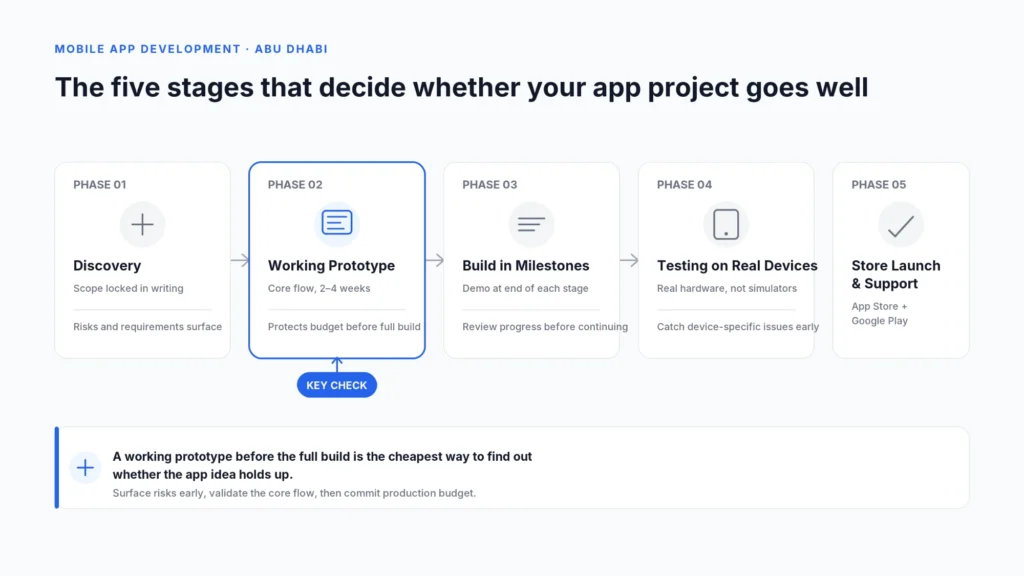
Mobile app development Abu Dhabi projects run through five phases — discovery, working prototype, milestone build, device testing, and store launch.
A well-run mobile app development Abu Dhabi project follows the same stages as any UAE build. Whether the client is in Abu Dhabi, Dubai, or anywhere else in the UAE, the difference between a smooth project and a painful one is how early the risks get surfaced.
- Discovery. A short, fixed-scope session that maps who will use the app, what it has to do on day one, and which parts are technically risky (payments, integrations, offline mode). Scope is locked in writing before design starts.
- Working prototype. A clickable, testable version of the core flow, typically in two to four weeks. This is where most budget gets protected: gaps in the idea show up when changing them is cheap.
- Build in milestones. The app and its backend are built in reviewed stages, with a demo at the end of each one, so you see real progress rather than a status report.
- Testing on real devices. Apps behave differently across phone models and OS versions. Testing on actual hardware, not just simulators, catches the problems your users would otherwise find first.
- Store launch and support. Submission to the App Store and Google Play, followed by a support plan for OS updates and fixes after go-live.
This five-phase approach applies to any mobile app development Abu Dhabi engagement, regardless of which emirate the vendor is based in. For a detailed look at how these stages translate into cost and timelines, our mobile app development cost guide breaks down native versus cross-platform builds and typical UAE developer rates.
What Is Different About Mobile App Development for the Abu Dhabi Market?
mobile app development Abu Dhabi work is subject to the same UAE federal framework as any other emirate — with a few sector-specific additions.
The technology is the same as anywhere in the UAE. The local factors in mobile app development Abu Dhabi clients are about audience and regulation — and they apply equally whether you engage a Dubai or Abu Dhabi vendor for your mobile app development Abu Dhabi project.
Sector rules: Abu Dhabi has its own regulators for some industries. As of 2026, healthcare apps that handle patient data are governed by the Department of Health Abu Dhabi rather than the Dubai Health Authority, and financial products fall under central bank and free-zone regulators with their own requirements. If your app touches a regulated sector, confirm the rules that apply to you early, because they can change the architecture. A vendor should be willing to say plainly when something needs a compliance review rather than guess.
Arabic and right-to-left support: Many Abu Dhabi audiences expect a proper Arabic experience, not a translated English one. Right-to-left layout affects every screen, so it is much cheaper to plan for it in the design stage than to retrofit it after launch. Retrofitting RTL support to a fully built app commonly doubles the design and front-end cost; building it in from the start is always the lower-risk option.
Local integrations: Mobile app development for Abu Dhabi businesses frequently requires local payment gateways, UAE Pass for identity login, SMS providers that work reliably with UAE carriers, and sometimes government service integrations. Each one adds scope that should be listed in the quote.
Store accounts: For any mobile app development Abu Dhabi, Apple and Google both require developer accounts to be tied to a verified legal entity. The App Store Review Guidelines cover what this means in practice. Set these up in your company’s name, not the vendor’s, so you control your own listing and can move vendors later without losing your app.
When Does a Local Abu Dhabi Presence Actually Matter?
Local presence matters in mobile app development Abu Dhabi contexts only in a small number of cases. If a contract carries a clause requiring physical custody of classified data, or a regulator has written on-premises hosting into the rules, a vendor’s ability to meet that requirement matters more than its address, and you should ask every shortlisted vendor, local or not, to show how they meet it in writing. Long embedded programmes with several engineers working on your site for a year or more are a different arrangement from a typical mobile app development project in Abu Dhabi.
For the large majority of business apps — customer apps, field-team tools, booking and loyalty apps, internal operations apps — none of those conditions apply. Mobile app development in Abu Dhabi from a Dubai-based team delivers the same outcome at the same legal standard.
Questions to Ask a Mobile App Development Vendor Before Signing
Run every mobile app development Abu Dhabi vendor through this checklist before you sign anything.
| Topic | What to ask | What a good answer looks like |
|---|---|---|
| Prototype | Do you build a working prototype before the full build? | Yes, covering the core flow, with your approval before the build proceeds |
| Native or cross-platform | Which approach do you recommend, and why? | A reasoned answer tied to your app’s needs, not a default |
| Payments | How are payments structured? | Tied to reviewed milestones, not time elapsed |
| Ownership | Who owns the code and the store listings? | You do, in writing, under accounts in your company’s name |
| Data | Where is data hosted and how is personal data handled? | A written policy and UAE or GCC-compliant hosting |
| After launch | What is covered once the app is live? | A defined support scope for OS updates and bug fixes |
| References | Can I speak to a UAE client? | Contactable references, with named apps you can download |
Before you shortlist any vendor for mobile app development in Abu Dhabi, run every candidate through the same set of questions. If you are still deciding whether to build with an external team at all, our comparison of in-house versus outsourced software development in the UAE covers the trade-offs. For web and business software beyond mobile, see custom software development for Abu Dhabi businesses.
Conclusion
mobile app development Abu Dhabi comes down to process and code ownership — not the vendor’s street address.
Choosing the right team for mobile app development Abu Dhabi comes down to process, ownership and relevant experience — not postcode. The vendor’s emirate of registration is irrelevant; their approach to mobile app development for Abu Dhabi clients is everything. A Dubai-based team that builds a prototype first, ties payment to reviewed milestones, and hands over the code and store accounts gives you the same protection as a local vendor, and often a faster start.
Tell us what you are trying to build. A short conversation will tell you more than any proposal.
Frequently Asked Questions
These are the most common questions buyers ask about mobile app development Abu Dhabi and remote vendor arrangements.
Can a Dubai company handle mobile app development for an Abu Dhabi business?
Yes. Mobile app development in Abu Dhabi follows the same federal legal framework as in Dubai. A Dubai-based developer is subject to the same data protection law and contract enforcement as an Abu Dhabi one. What matters is the vendor’s process, references and what you own at handover.
Do we need to meet in person during the project?
Usually once, at the start, for a kick-off workshop. Dubai to Abu Dhabi is about a 90-minute drive, and later stages such as demo reviews, design sign-off and testing work well over video. In-person sessions are added when a milestone benefits from them.
How much does mobile app development Abu Dhabi cost?
Cost depends on the platform approach and the backend, not on where you are based. As a frame, a simple cross-platform app with a basic backend commonly lands in the AED 55,000 to 150,000 range for a fixed-scope build, and apps with payments or real-time features cost more. See our mobile app development cost guide for the full breakdown.
Does my Abu Dhabi app need Arabic support?
If your audience includes Arabic speakers, yes, and it should be planned at the design stage. Right-to-left layout affects every screen, so retrofitting it after launch costs far more than building it in from the start.
Who should own the App Store and Google Play accounts for mobile app development Abu Dhabi?
You should. Create the developer accounts in your company’s name and give the vendor access, rather than publishing under the vendor’s account. That keeps the listing, reviews and downloads yours if you ever change vendors.
Usually a reply within one working day.