Article Overview
Custom software development outsourcing means handing the design, build and testing of your software to an outside company. This guide explains when it fits a UAE business, how it is priced, how to choose a partner and what the contract and the data rules must cover. It also compares outsourcing custom software development with an in-house team, and gives a five-question test to decide.
If you decide to buy outside help, custom software built around how your company works starts with your process and a written scope, not with a headcount.
- Custom software development outsourcing buys a result for a project, while an in-house team buys capacity that you manage every day. Choose by how steady the work is, not by which option looks cheaper on a first quote.
- Price outsourcing three ways: a fixed price for a defined scope, time and materials for open work, or a dedicated team charged by period. Each moves risk differently, so match the model to how certain your scope is.
- In the UAE, an employee costs more than the salary. One 2026 guide puts the full cost of a hire between 30 and 50 percent above base pay once benefits, visa and overhead are counted, before notice and gratuity.
- Data rules follow the work. The UAE personal data law applies to processing inside or outside the country, so outsourcing custom software development abroad needs a clear transfer route and a contract that binds the supplier.
What Is Custom Software Development Outsourcing?
Custom software development outsourcing is the practice of paying an outside company to design, build and test software for you, instead of hiring and managing the developers yourself. The supplier carries the staffing, and you carry the brief and the review. Custom software development outsourcing therefore moves effort from recruiting to supervision. In fact, custom software outsourcing turns a hiring problem into a management problem, which suits some companies and not others.
People use several names for this. Software outsourcing, software development outsourcing and outsourcing custom software development all describe the same idea, and custom software development outsourcing is the most exact. Companies that outsource software development often start with one project, then decide whether to repeat the model. The details differ by contract: some buyers pay a fixed price for a defined result, and others pay for a team’s time. In both cases, the buyer owns the question and the supplier owns the staffing.
What Do Outsourced Custom Software Development Services Cover?
Outsourced custom software development services usually cover discovery, design, build, testing and handover. In addition, some suppliers offer support after launch. A buyer who wants to outsource custom software development services should ask which of these stages the price includes, because the stages differ widely. The phrase outsource custom software development services offering often appears in supplier pages, and it means the same list.
A fixed scope is easiest to outsource. However, ongoing product work is harder, because the brief changes every week. In that case, custom software development outsourcing needs a steady rhythm of reviews, and the plan should name who attends them. Our guide on custom software development cost in Dubai shows what each stage costs, so you can compare the stages on one sheet. Suppliers that outsource custom software development services offering end-to-end delivery should also state who owns each stage.
Send Latent the work you need built, how long it will last and the team you have today. Latent will say plainly which parts suit a partner, which suit staff and where a mix fits.
When Does Outsourcing Fit Your Business?
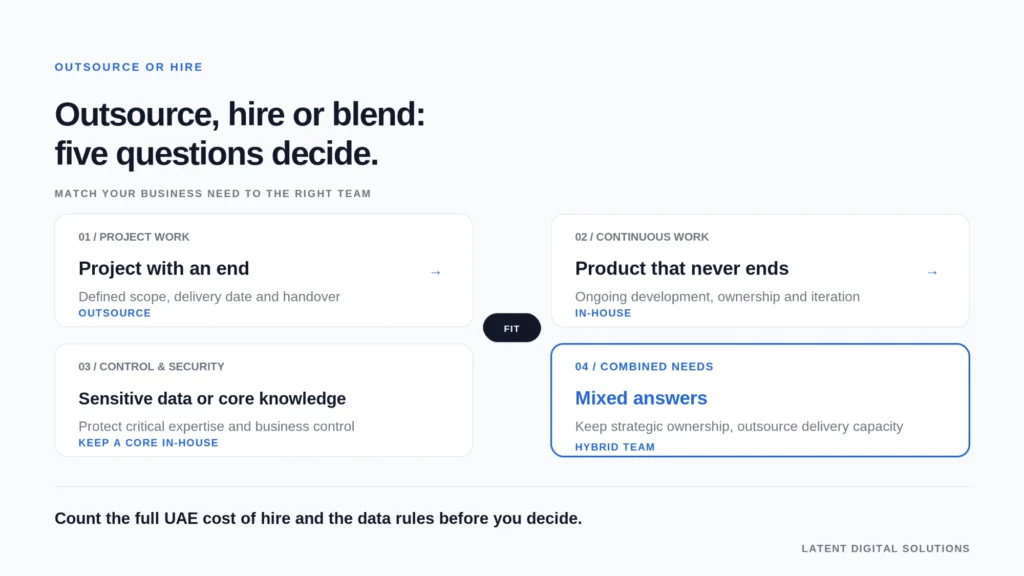
Decide on custom software development outsourcing with five questions about your own work. Write the answers down:
- Is the work a project with an end, or a product that never ends? Projects favour outsourcing, products favour in-house.
- Can you hire and keep skilled people within your timeline? If not, a partner is faster.
- Do you have someone who can write a brief and review code? If not, outsourcing is risky.
- Does the work involve sensitive data? If yes, favour local control or strict terms.
- Will the knowledge be a core asset? If yes, keep the core in-house.
Mixed answers point to the hybrid in any in house software development vs outsourcing decision. Therefore, treat the five answers as a brief for any supplier, and compare their replies on one sheet.
What Does Outsourcing Cost, and How Is It Priced?
Custom software development outsourcing is priced in three common ways. A fixed price is a known total for a defined scope. Time and materials is a charge for hours worked at agreed rates. A dedicated team charges by period for people who work only on your product. Each moves risk differently: a fixed price puts overrun risk on the supplier, while the other two put it on you. Therefore, match the pricing model to how certain your scope is.
Custom software development outsourcing works best when the brief is written down first. A short scope, a list of users and a measure of success let a supplier quote the work and not the doubt. In contrast, a vague brief produces a high fixed price or an open-ended bill. Ask every supplier to price the same written scope, and compare the answers on one sheet. A supplier that works inside your approvals and systems prices the work more accurately.
What Else Appears on the Outsourcing Bill?
A supplier’s rate is not the whole cost of custom software development outsourcing. Project management, testing and support after launch are real lines, and some suppliers include them while others charge for them separately. However, change requests add cost once the build starts, so ask how each one is priced. Your own time counts too: someone must answer questions and review each release.
In addition, if the supplier works abroad, add currency movements, tax treatment and the effort of checking the work across time zones. None of these makes outsourcing a poor choice. Each is a line to price before you decide, so that the comparison with an in-house team covers the same items on both sides. Ask for the bill in advance, line by line, so nothing is a surprise later.
What Does an In-House Team Really Cost in the UAE?
An in-house team costs more than salaries, and in the UAE the extra lines are specific. Custom software development outsourcing should be priced against that full cost. From our research, Wuzzuf’s 2026 guide to Dubai engineer costs says a hire usually costs between 1.3 and 1.5 times the base pay after benefits, visa and overhead are added. We found that the same guide treats salary as only the starting point of the budget.
In addition, employment brings notice periods and end-of-service gratuity, whose current rules you should confirm with the Ministry of Human Resources and Emiratisation. Recruiting also adds agency fees and months of search. Therefore, compare a partner’s price with the full cost of hire, not with salary alone. Treat each line as a cost that exists whether or not a payslip shows it. Ask your finance lead to price a first hire over twelve months, including recruiting, the visa and the weeks before the person is productive.
What Hidden Costs Sit Beyond Salary?
Four costs are easy to miss. First, idle time: salaried developers are paid between projects. In addition, management time comes second, because someone must run planning, review and career conversations. Tools and training come third. Turnover comes fourth, since a leaving developer takes knowledge with them and the replacement needs months to reach the same pace. None of these appears in a custom software development outsourcing quote, and each costs money even when no invoice shows it.
In fact, none of these lines appears on a payslip, yet each reaches the budget. In contrast, custom software development outsourcing shows most of them inside one price. That does not make outsourcing cheaper. It makes the cost easier to see. As a result, a fair comparison lists each cost for both options, over the same period, in one table. Custom software development outsourcing should be judged on the same lines.
In-House vs Outsourcing Software Development
Custom software development outsourcing is often set against hiring. Searches use several word orders: in-house vs outsourcing software development, in house vs outsourcing software development, in-house software development vs outsourcing, in house software development vs outsourcing and software development in house vs outsourcing. All of them ask one question, and custom software development outsourcing is one answer. Do you want to employ the people who build your software, or buy the result from a company that does?
The honest answer depends on five factors. Cost over time comes first. Speed to start, control over priorities, key-person risk and retained knowledge follow. The table compares them. Importantly, neither column wins every row, which is why the decision is about your situation and not about a general rule.
How Do the Five Factors Compare?
| Factor | In-house team | Outsourced team |
|---|---|---|
| Cost over time | Steady, and rises with each hire. | Varies with the project and ends with it. |
| Speed to start | Slow, because hiring takes months. | Quick, if the supplier has free people. |
| Control | High, because you set daily priorities. | Shared, through the contract and reviews. |
| Key-person risk | Held by you, and hard to cover. | Spread across the supplier’s team. |
| Knowledge | Stays in the company. | Must be transferred in writing. |
Owners who search in house vs outsourcing software development often expect a single winner. In practice, in-house software development vs outsourcing is a trade-off between control and flexibility. Custom software development outsourcing is only one side of it. Rank each factor from one to five for your own business before you read any proposal, and write the score beside each factor so everyone who decides can see it. Our work on solving business problems with technology starts by naming the problem and its weekly cost, which shows how steady the work really is.
What Are the Pros and Cons of Outsourcing?
The pros and cons of outsourcing software development start with speed and access. For example, a supplier can start in weeks, bring skills you do not employ and add or remove people as the project changes. You pay for the result, and the supplier carries the staffing risk. For a one-off build, that is a strong case, and it explains why custom software development outsourcing is popular. Speed matters most when a market window or a deadline is fixed.
The cons of custom software development outsourcing are real as well. However, you have less control over who does the work, and priorities can drift between reviews. Knowledge sits with the supplier unless the contract requires handover. In addition, a poor brief produces poor software at any price. Therefore, weigh the pros and cons of outsourcing software development against your own ability to write a brief and review the work.
Where Does Custom Software Development Outsourcing Go Wrong?
Custom software development outsourcing goes wrong in predictable places. For instance, the brief is vague, so the supplier fills the gaps with guesses. Reviews are infrequent, so errors compound. Ownership is unclear, so the buyer cannot move the code. A change is requested late, and its price is argued. Each of these problems is visible in advance, and each can be addressed in the contract. Name an owner for each risk.
Custom software development outsourcing also fails when the buyer treats the supplier as a black box. A weekly demonstration of working software keeps both sides honest. It also gives you early evidence of progress. If the supplier cannot show progress each week, ask why. Outsourcing custom software development works best when the buyer stays involved, even though the supplier does the building.
When Does In-House Development Make Sense?
Custom software development outsourcing is usually the wrong fit when the software is the product itself. If you are building a platform that customers use directly, such as a fintech application, a marketplace or an enterprise product, the work needs knowledge of the business that is slow to pass to a supplier. A team that lives with the product every day makes quicker decisions, and the knowledge stays in the company.
A steady backlog is the second sign. When useful work exists every week for years, salaried people are used well and idle time stays low. An old system that only your staff understand is a third case for keeping a core team close, even when a partner helps with modernizing an old system. Therefore, ask what you would lose if the people who know the system left.
Which Signs Favour an In-House Team?
Check each sign honestly against your own situation, not the one you would like to have. These signs point towards hiring:
- Software is the product: customers use what you build every day.
- Steady backlog: useful work exists every week, for years.
- Sensitive data: control is simpler when the work sits close to the business.
- Core knowledge: the details of the system are a company asset.
Write down which signs apply and which do not, and keep that note with the budget. Therefore, if most of these apply, build a core team and treat outside help as a way to add capacity. If few apply, custom software development outsourcing is usually the better start, and you can hire later when the product is proven. Either way, compare the full cost of both options before you commit.
How Do You Choose an Outsourcing Partner?
Custom software development outsourcing is safest when you start with a written scope and a small first stage. Ask suppliers for the same breakdown: roles, hours or fixed price, testing and support. As a result, the quotes become comparable. Check references from similar projects. Then sign a contract that covers change control, acceptance tests, a spending cap, source code ownership and an exit route. A good partner works inside your approvals and systems and welcomes these terms.
Custom software development outsourcing works best when payment follows delivery. Outsourced custom software development services should be paid by stage. Each payment follows a delivered, tested result. That keeps the supplier’s incentive aligned with yours. When you outsource custom software development services offering a long list of features, insist that the first stage is small. A short first project tests the relationship cheaply before you commit the whole budget. Review it honestly before you extend. To pick the supplier, use our guide on how to choose a custom software development company in Dubai.
What Should a Custom Software Development Outsourcing Contract Include?
A contract is only as useful as its terms. These terms protect the buyer in any custom software outsourcing contract, and each one is easy to negotiate before work starts:
- Change control: every change is costed and signed off before work on it begins.
- Acceptance tests: the checks that each release must pass before you pay.
- Source code ownership: you own the code, the data and the designs.
- Knowledge transfer: documentation and handover sessions at each stage.
- Exit route: the steps for ending the contract and what you take with you.
Each term turns a likely dispute into a written rule, which is cheaper than arguing about it later. Importantly, the same terms apply whether the supplier is local or abroad. Where the work crosses a border, add the data terms covered in the next section.
How Do You Hand the Work Over to Your Own Team Later?
Plan the handover of custom software development outsourcing on day one, because a project that ends without one leaves you dependent on the supplier. Ask for documentation at every stage, not only at the end, and for the full codebase in a repository you control. Schedule walk-through sessions for your staff, and record them. List the accounts and access rights the supplier holds, and plan their return. Custom software development outsourcing is easier to defend when the way out is as clear as the way in.
In fact, you should test the handover before you need it. Ask one of your own people, or an independent reviewer, to build and run the system from the documents alone. As a result, if that fails, the documents are not good enough yet. Fix them while the supplier is still engaged, as the supplier’s goodwill is greatest during delivery and fades after the final payment. Platform decisions at this stage need their own due diligence, and our ERP implementation guide shows how.
Which Data Rules Follow the Work Abroad?
Custom software development outsourcing carries data rules wherever the developers sit. From our research, the UAE government’s page on data protection laws says the Personal Data Protection Law applies to processing inside or outside the country. It also sets rules for moving personal data to another country and for sharing it. The law has applied since 2 January 2022 (page updated 4 Dec 2025).
We found that BusinessDubai’s August 2026 note on the UAE data law (10 Aug 2026) says the Executive Regulations have still not been issued. Therefore, detailed transfer mechanics may change, so ask any foreign supplier where data will be stored and how the transfer is covered. Put the answer in the contract, with the date of the rules you relied on. Review that answer each year, because the rules are still being completed.
Can You Keep Customer Data in the UAE?
Custom software development outsourcing can often keep personal data in the UAE, by designing the project so that it never leaves the country. For example, developers can work on test data instead of live records, and production systems can run in a UAE data centre. This reduces the transfer question to a minimum. Document the choice, so a new colleague can see why the data stays where it does. In addition, it simplifies the contract, because the supplier handles less sensitive material.
However, when developers must see live data, the contract should say who can access it, from where and for how long. Nearshore suppliers sometimes simplify the time zone question, but not the data question. Always take legal advice on the transfer route for your own data, because the rules depend on the data and the destination.
Is a Hybrid Team the Better Answer?
A hybrid team is a small core kept in-house, with a partner used for peaks and specialist work. Software development in house vs outsourcing is therefore not all-or-nothing, and custom software development outsourcing can cover only the peaks. The core owns the product, the priorities and the knowledge. The partner adds capacity for a build or a launch, then steps back. For many growing companies, this is the practical way to outsource software development without losing control of the product. The usual first step is a first version before permanent hires, and MVP to production covers what follows.
However, the hybrid model has its own demands. The core team must be able to review the partner’s work, which means at least one senior person on your side. Therefore, handover must be planned from the first week. As a result, costs fall between the two pure models, and so do risks. In contrast, a hybrid is easier to adjust than a large permanent team.
How Do You Run a Hybrid Team Day to Day?
Name one person on your side who owns the product, sets the priorities and speaks for the business. That person meets the partner’s lead every week, reviews the work and accepts or rejects each release. Importantly, keep the rules simple: one backlog, one place for decisions and one calendar for reviews. A hybrid with custom software development outsourcing for peaks fails when two groups each think the other is deciding.
For example, share the standards with the partner, including how code is reviewed and tested, so both sides work to the same bar. In addition, rotate people between the two groups for short periods when you can, since shared experience builds trust faster than documents. Review the split every quarter and move work in-house or outside as the product and the budget change. Write each change down.
Send Latent your five answers and the scope in a few lines. Latent will say what the build needs and how to structure the work around your approvals and systems.
Conclusion
Custom software development outsourcing suits project work, speed and skills you do not employ. It lets a company outsource software development without hiring first. An in-house team suits continuous product work and knowledge you want to keep. In the UAE, count the full cost of hire and the data rules before you decide. In-house software development vs outsourcing is therefore a question about your situation, and a hybrid team is often the practical answer. Set the pros and cons of outsourcing software development beside your own capacity to manage it. Check custom software outsourcing terms before you sign.
Write your five answers on one page, then compare custom software development outsourcing quotes against the full cost of your own team. For a second view, talk to Latent about your team options and send that page.
Frequently Asked Questions
Is in-house vs outsourcing software development cheaper one way or the other?
Neither is cheaper by default. Custom software development outsourcing varies with the project, while an in-house team has a steady cost that includes visa, notice and gratuity. Therefore, compare the full cost of both over the same period.
Should I choose in house vs outsourcing software development for a first product?
Custom software development outsourcing is often faster for a first build, because hiring takes months. However, keep ownership of the code and plan the handover, so you can bring the work in-house later.
What are the risks of in-house software development vs outsourcing?
In-house risks are slow hiring and key-person loss. Custom software development outsourcing risks are vague briefs, drifting priorities and unclear ownership. However, both are manageable with a written scope and regular reviews.
How do I weigh in house software development vs outsourcing for sensitive data?
Check where the data will be processed and how any transfer is covered. In addition, keep live data in the UAE where possible and give the supplier test data.
When does software development in house vs outsourcing favour a hybrid?
A hybrid fits when you need a core that owns the product plus extra capacity for peaks. As a result, you keep control of priorities and still add speed when it matters.
Is outsourcing custom software development the same as hiring a dedicated team?
Not exactly. Custom software development outsourcing usually buys a defined result, while a dedicated team provides capacity you direct. Choose by whether you want to manage the work.
Usually a reply within one working day.