Article Overview
Building a credible AI transformation strategy is harder than it looks. The planning phase feels productive: use cases are identified, budgets are approved, and the roadmap is presented to leadership. Six months later, the programme is stalled. For UAE business owners, the failure modes are even more specific: government mandates, bilingual system requirements, and Emiratisation constraints create blockers that no generic framework accounts for. This is what AI transformation for UAE businesses actually requires to work. This article breaks down what an AI transformation strategy actually needs to contain, where to start, and what to stop doing immediately.
AI transformation examples from UAE businesses — see what financial services, healthcare, logistics, and retail companies are deploying in production, sector by sector.
- An AI transformation strategy fails not because the technology is wrong, but because the change plan (who owns what, who changes how) is missing entirely.
- Choosing where to start matters more than choosing which AI to use. The best first process is the one that runs on known, consistent data with a single team owning the outcome.
- UAE businesses face four specific blockers that Western frameworks ignore: Emiratisation quotas, bilingual output requirements, PDPL compliance costs, and government mandate timelines.
- A quarterly review cadence is not optional. An AI transformation strategy that has not been revisited in six months is almost certainly out of date.
Why do most AI transformation strategies fail before they deliver?
The gap between strategy and operations
Most businesses treat an AI transformation strategy as a planning exercise. They define goals, identify use cases, assign budget, and present the result. The document looks credible. The goals are reasonable. Then the programme launches and stalls within six months.
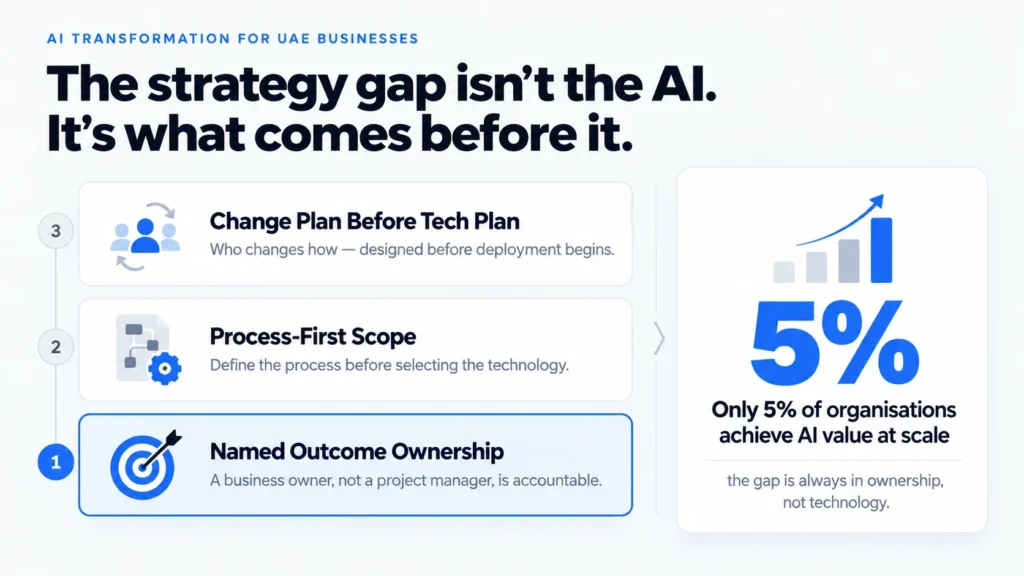
The failure rarely comes from the AI itself. In 2025, research aggregated by Larridin from BCG and MIT findings showed only 5% of organisations achieve meaningful value from AI at scale. The gap is almost always found in the same place: the strategy describes what should happen, but not how the people and processes in the business will change to make it happen.
An AI system does not replace a task. It replaces a workflow that a person currently owns, interprets, and handles exceptions on. Without a plan for that person’s role in the new workflow, the AI gets worked around or abandoned.
Why pilots do not become programmes
Most UAE businesses that have invested in AI can point to at least one successful pilot. The invoice automation that saved four hours a week. The chatbot that handled 60% of support queries. The demand forecast that outperformed the spreadsheet.
The pilot worked. The programme did not. The difference is almost always ownership. A pilot runs with a named sponsor who champions it. A programme requires every team that touches the workflow to change how they operate, and no one budgeted for that change management work. For a structured model on how to close that gap, see the enterprise AI implementation guide.
An AI transformation strategy that stays at the pilot stage never got connected to an operational plan. That is not the same as a failed AI project. A well-built AI transformation strategy accounts for this before the technology is ever selected.
What does an AI transformation strategy actually need to contain?
An AI transformation strategy must contain three things that most strategy documents skip:
- A named business owner for each outcome
- A process-first scope definition
- A change management plan that precedes technology selection
Outcome ownership, not just technology selection
In any AI transformation strategy, the most important decision is not which technology to deploy. The person who owns the outcome determines whether the programme succeeds or stalls.
Every part of the programme that will change how a team operates needs a named business owner, not an IT lead or project manager. A business owner who has the authority to change the workflow and the accountability to deliver the result.
Before selecting any technology, an AI transformation strategy should answer: who in this business is accountable for this outcome, and do they have the authority to change what they own?
For UAE businesses, this question has an added layer. The outcome owner may also need to navigate Emiratisation requirements that affect which roles within the impacted workflow can change and on what timeline. A strategy built without this accountability layer will stall the moment it hits the first handoff between teams.
A process-first, not AI-first, scope
Scope definition matters as much as ownership. It should start with a business process, not a technology selection.
| AI-first scope | Process-first scope | |
|---|---|---|
| Framing | “Implement a generative AI solution to improve customer operations” | “Reduce customer enquiry to proposal from five days to one, by removing two manual handoffs” |
| Evaluable? | No: no metric to test against | Yes: measurable start and end state |
| Technology decision | Must be made before the problem is understood | Follows naturally from the process definition |
The second version is specific enough to evaluate, measure, and own. It also leads naturally to the right technology choice, because you know exactly what you are trying to change.
How do you choose where your AI transformation strategy starts?
Identifying the one process worth starting with
Not every business problem is a good starting point for an AI transformation strategy. The right first process shares three characteristics.
-
Consistent, known data. AI performs well when the inputs are predictable. A process that depends on informal knowledge, undocumented exceptions, or highly variable inputs will produce unreliable outputs, and those unreliable outputs will undermine confidence in the entire programme.
-
Contained within one team. A process that spans multiple departments, relies on external systems, or feeds into a regulatory reporting chain introduces risk at every boundary. The best first process is one that a single team can change and own.
-
A measurable outcome. “Improve customer experience” is not measurable. “Reduce the time from enquiry to first response from 24 hours to 2 hours” is. The measurable outcome is what makes the first initiative convincing enough to fund the next one.
These three criteria narrow the field significantly. A focused AI transformation strategy starts with one well-chosen process and runs it to production before expanding.
What to defer
- Defer any process involving compliance uncertainty: particularly anything touching personal data under the UAE’s PDPL. Getting this wrong delays the project by months, not just adds a fine.
- Defer any process requiring accurate Arabic language output. Arabic NLP has improved, but bilingual output requirements remain a reliable source of unexpected project extension.
- Defer any process involving roles subject to Emiratisation quotas until the workforce transition plan is in place. This constraint catches every AI transformation strategy built on a Western framework that does not account for it.
Understanding AI in business statistics for the UAE specifically helps set realistic expectations for how long each phase takes in this market.
What does the change plan look like before the technology plan?
Who needs to change before the system does
An AI transformation strategy begins with people, not software. Before any technology is selected, the change plan should answer four questions.
- Who currently does the work this AI will change, and what happens to their role? Most AI implementations shift human work toward judgment and exception-handling rather than eliminating it. But that shift needs to be designed, not discovered mid-project.
- Who will maintain the AI system once it is in production? Every AI system produces errors, requires updates, and occasionally produces outputs that need human review. Without a named owner for ongoing maintenance, the system degrades.
- What does the workflow look like during the transition? There is always a period, often longer than expected, where the old process and the new process run in parallel. Dual-running costs time and creates confusion unless it is planned deliberately.
- How will the team know the AI is performing correctly? An AI transformation strategy that defines success metrics before deployment is significantly more likely to reach production than one that defines them afterwards.
The adoption question most strategies skip
Most change management frameworks focus on training: how do we teach the team to use the new system? This is necessary but insufficient.
The harder question is motivation: why would a team member use the new system when they already know the old way, and the old way works?
The problem here is not technical, it is managerial. Teams rarely adopt new systems because they are better; they adopt them because the old way stops being an option, or because performance is now measured against the new one.
An AI transformation strategy that does not address adoption will produce the most common of all programme failure modes: a fully functional system that nobody uses.
How do you keep an AI transformation strategy current?
Quarterly review structure
An AI transformation strategy is not a one-time document. It should be reviewed on a defined schedule: quarterly for most businesses, or after any significant change to the regulatory or technology environment.
A useful quarterly review covers three things:
- Which initiatives are in production, in pilot, or stalled? Stalled initiatives are signals, not failures. The signal almost always points to an unresolved ownership issue, a missing data input, or a compliance hurdle that was not anticipated.
- What has changed in the AI market that affects what is now possible or affordable? The technology is moving quickly enough that a capability that was cost-prohibitive six months ago may now be within reach.
- What has changed in the business itself? An AI transformation strategy built for last year’s process map may no longer reflect how the business actually operates.
When to revise versus when to stop
Not every AI initiative is worth continuing. A useful decision framework asks: if we were deciding to start this initiative today, knowing what we know now, would we fund it?
If the answer is no, stopping cleanly is usually better than continuing to invest. Continuing a failing initiative costs more than stopping, measured in budget, team attention, and credibility for future AI projects. Our AI transformation consulting framework includes a quarterly initiative review template for exactly this decision.
What do UAE businesses get wrong that others do not?
UAE businesses face four specific constraints that make a generic AI transformation strategy unreliable as a starting point.
- Emiratisation requirements constrain which roles within an impacted workflow can change, and on what timeline. An AI programme that automates a role with an Emiratisation target needs a workforce transition plan that satisfies both the operational goal and the quota. A strategy built without this constraint will encounter it mid-programme, when changing direction is expensive.
- Bilingual output requirements are consistently underestimated. Many UAE businesses operate across Arabic and English: customer communications, legal documents, regulatory submissions. An AI system that produces reliable English output but inconsistent Arabic output is not a complete solution.
- PDPL compliance timelines inflate project scope. The UAE’s Personal Data Protection Law requires data protection impact assessments for AI systems that process personal data. These assessments take time and may require changes to the data architecture before a project can proceed.
- Government mandate adoption creates forcing functions that Western markets do not face. E-invoicing requirements, mandatory AI disclosures, and similar mandates change the timeline and prioritisation of an AI transformation strategy in ways no generic framework anticipates.
Conclusion
A reliable AI transformation strategy is built on three foundations that most planning frameworks skip: named outcome ownership, a process-first scope, and a change plan that precedes the technology selection.
For UAE businesses, those foundations are necessary but not sufficient. The additional layer is an honest accounting of four UAE-specific constraints (Emiratisation, bilingual requirements, PDPL compliance, and government mandates) that determine what is actually buildable in your market and your timeline.
The most ambitious AI transformation strategy documents rarely belong to the businesses that succeed. The ones that succeed pick one well-defined process, build ownership around it, and run it to production before expanding.
If you are building or reviewing your AI transformation strategy, talk to our team about how to scope the first phase.
Frequently Asked Questions
What is the difference between an AI strategy and an AI transformation strategy?
An AI strategy identifies where AI could be valuable in a business. An AI transformation strategy is the operational plan for actually changing how the business works to capture that value. One is a prioritised list of opportunities; the other is a programme with named owners, change plans, and measurable outcomes attached.
How long does it take to build an AI transformation strategy?
For a mid-size UAE business, a working first version typically takes four to six weeks, enough time to map the candidate processes, validate the data availability, identify the outcome owners, and set initial success metrics. A strategy built faster than that is usually an ambitious document, not an operational plan.
What should an AI transformation strategy include?
At minimum: a prioritised list of processes to transform, a named outcome owner for each, a process-first scope definition, a change management plan that precedes technology selection, a data readiness check for each initiative, and a quarterly review cadence. For UAE businesses, it should also include an explicit assessment of Emiratisation, bilingual, PDPL, and government mandate constraints.
How often should an AI transformation strategy be reviewed?
Quarterly is the right cadence for most businesses, with an additional review whenever the regulatory environment changes significantly or a major initiative stalls. An AI transformation strategy that has not been revisited in more than six months is almost certainly out of date.
What comes first: the AI strategy or the change plan?
The change plan, or at least the questions it will answer. Technology selection without knowing who owns the outcome, who maintains the system, and how the team will adopt the new workflow produces a well-designed AI implementation that nobody uses. The people side of an AI transformation strategy is harder and slower than the technology side; starting it first gives it the runway it needs.
Usually a reply within one working day.