Article Overview
AI in UAE banking is no longer a strategy document — it is live production. Three major UAE banks (Emirates NBD, FAB, and Mashreq) have publicly committed to AI deployment across operations. But the Central Bank of the UAE (CBUAE) has also published binding guidance for all licensed financial institutions.
The gap: what does this mean for a regional bank, insurance company, or fintech that is not in the Fortune 500 bracket? Three use cases are live today, and CBUAE compliance is achievable. At Latent Digital Solutions, we help financial services businesses navigate this landscape. The regulatory requirements are clear; the technology is proven; the path forward exists.
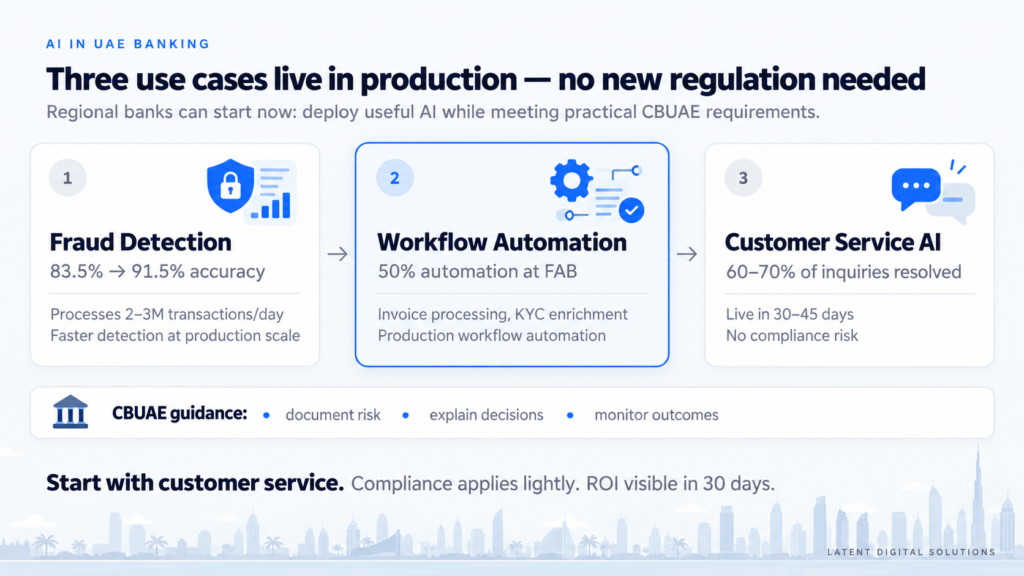
- Three AI use cases are currently deployed in UAE banks: fraud detection (83.5%→91.5% accuracy improvement), workflow automation (50% efficiency gain at FAB), and customer service automation (60–70% of inquiries resolved by AI).
- The Central Bank of the UAE published AI guidance for licensed institutions in its rulebook (rulebook.centralbank.ae), which is binding but permissive—it does not block AI deployment, it structures it.
- Regional banks and fintech companies that are not part of the Big 3 can deploy AI without waiting for new regulation; CBUAE guidance applies to all licensed financial services businesses, not just major banks.
What AI Use Cases Are Live in UAE Banking?
AI in UAE banking moved from pilot to production across multiple institutions between 2024 and 2026. The three use cases driving AI in UAE banking today are fraud detection, workflow automation, and customer service. The Banker magazine reported in June 2026 that First Abu Dhabi Bank achieved 50% automation and 75% workflow efficiency improvement through agentic AI (The Banker, June 2026). This is not a proof of concept. It is live production. Three specific use cases are operating today across UAE financial services.
1. Fraud detection and anti-money laundering
Fraud detection is the most mature application of AI in UAE banking today. Emirates NBD and FAB both run AI-powered fraud detection systems. The improvement is measurable: AI-powered fraud detection boosted accuracy from 83.5% to 91.5% across GCC banks. The real driver: FAB’s system processes 2–3 million transactions per day. Manual review of even 1% requires staffing that no bank wants to maintain. AI does not replace the compliance officer. It filters noise.
2. Workflow automation for back-office processes
Workflow automation is the second pillar of AI in UAE banking deployments. Invoice processing, KYC (Know Your Customer) data enrichment, and statement reconciliation are the prime candidates. A single invoice processing automation in a regional bank saves 15–20 hours per week per person. FAB’s deployment delivered 50% automation, meaning half the bank’s workflow touches AI at some point—not end-to-end autonomy, but selective bottleneck removal. This is your second viable entry point.
3. Customer-facing automation: chatbots and inquiry routing
Customer service automation is the fastest entry point for AI in UAE banking. Emirates NBD’s customer service team reports that 60–70% of incoming customer inquiries can be resolved automatically by an AI agent trained on the bank’s own FAQ and past conversations. The system routes complex cases to humans. This is your highest-probability quick win because the outcome is visible in 30–45 days and does not touch regulated compliance workflows.
Banks run AI today, and licensed institutions must follow central bank guidance. Latent helps regional banks pick an entry point that fits both.
Why the CBUAE Rulebook Actually Matters for Your Bank
The regulatory framework for AI in UAE banking is permissive by design — it does not block deployment, it structures it. The Central Bank of the UAE published guidance on AI in UAE banking — specifically “Big Data Analytics and Artificial Intelligence (AI) for Licensed Financial Institutions” in the CBUAE Rulebook. This is binding guidance. It does not ban AI. It requires that you document four things:
- Risk assessment for the specific AI system — what could go wrong, what is the impact, what is the mitigation?
- Data provenance and quality — where does the training data come from, how is it cleaned, how is it updated?
- Explainability of model decisions — for systems that affect customer outcomes (credit decisions, fraud blocks, pricing), you must be able to explain why the system said yes or no.
- Ongoing monitoring and audit — you cannot deploy and forget. You must track whether the model’s predictions match reality over time.
For a fraud detection system, this means: document your fraud model’s false-positive rate, track whether flagged transactions are actually fraudulent, and retrain or notify the regulator if accuracy drifts. For a customer service chatbot, it is simpler: track whether the bot answers accurately and route unsure cases to a human.
The CBUAE guidance is permissive. It does not say “AI is banned for regional banks.” It says “if you use AI, document that you did it properly.” This is the legal surface. The business reality is simpler: if you are not Emirates NBD, you cannot hire 20 data scientists. You partner with a vendor or a specialist firm, you deploy their tested model, you monitor it, and you run your bank. Many regional banks find that moving from pilot to production needs structured deployment planning. The CBUAE framework actually supports this. That is what First Abu Dhabi Bank did.
The Regulatory Differences Between a Regional Bank and a Mega-Bank
Not all AI in UAE banking deployments face the same compliance depth. The regulatory picture for AI in UAE banking varies by institution size. The size of your institution shapes how the CBUAE guidance applies.
Mega-banks: Emirates NBD, FAB, Mashreq
The CBUAE applies full supervision here. These are Systemically Important Financial Institutions (SIFIs). Their AI systems are part of annual regulatory exams. The compliance burden is visible, expensive, and real.
Regional banks, insurance companies, and fintech firms (50–2,000 staff)
The CBUAE guidance applies, but the supervision is risk-based. A small bank deploying a customer service chatbot does not face the same compliance depth as a mega-bank deploying a credit-decisioning AI system. The principle is identical (document risk, explain decisions, monitor outcomes). The workload is proportional.
Free-zone entities: DIFC and ADGM
The applicable regulator is the DFSA or ADGM regulator, not the CBUAE. Their AI guidance is separate. If your bank is in the DIFC, you follow DFSA guidance for AI, which is published and more mature than CBUAE guidance.
The gap that no one articulates: a mid-sized regional bank wants to know if it can actually deploy a fraud detection AI without hiring a dedicated regulatory affairs person. The answer is yes—if the system is pre-built and pre-audited by the vendor. The bank’s job is to configure it for your data, monitor it, and document that you did. This is a 6-8 week onboarding, not a 12-month compliance project.
Where Most UAE Financial Services Institutions Are Getting Stuck
The biggest barriers to AI in UAE banking are not regulatory — they are internal. Understanding these blockers is essential for any institution planning AI in UAE banking deployments in 2026–2027. Three blockers appear again and again:
1. Vendor lock-in perception
Regional banks fear that deploying one vendor’s AI system creates dependency. The CBUAE guidance does not require you to build your own AI. It requires you to understand what you are deploying and to monitor it. You can use a vendor’s model. You cannot deploy it blindly.
2. Data residency uncertainty
The CBUAE does not mandate that data stays in the UAE. But if your data leaves the UAE, you must document why (backup, model training, business continuity) and you must ensure it is re-encrypted in transit and at rest. DIFC and ADGM have stricter rules. A regional bank in Sharjah or Ras Al Khaimah faces different constraints than one in Abu Dhabi.
3. Explainability for non-technical compliance officers
Large models (LLMs, deep neural networks) are hard to explain. A traditional regression model says “this loan gets declined because the debt-to-income ratio exceeds 0.45.” A neural network says “this loan is declined.” The CBUAE wants explainability. For customer service, this is easy—log the chatbot’s responses. For credit decisions, you need a vendor who can produce a decision report. Most fintech vendors now do. Banks following the enterprise AI implementation framework will recognise this as the governance layer. The same documentation discipline applies whether you deploy a chatbot or a credit model. Your job is to ask and verify before onboarding.
Three Entry Points for Regional Banks
AI in UAE banking starts at one of three points — choosing the wrong entry point is the most common reason AI in UAE banking deployments stall. If you are a regional bank and want to deploy AI in 2026–2027:
1. Start with customer service
A chatbot trained on your FAQ, policies, and past interactions costs 50,000–100,000 AED to implement and takes 60 days. CBUAE guidance applies lightly because no regulated decision is being made. The bot answers questions; humans handle exceptions. ROI is visible in 30 days (support team time saved). Compliance is: you document what the bot is trained on, you monitor its accuracy, you route failures to humans. Latent’s MVP to Production service specializes in this rapid deployment model.
2. Second wave: fraud detection or KYC enrichment
Once the first automation is running, you have infrastructure and internal expertise. Fraud detection for a mid-sized bank means: you feed 12 months of transaction history to a pre-built model, the model learns your baseline, it flags outliers, your team investigates. CBUAE compliance requirements are stricter here — you must explain why a transaction was flagged. But the framework already exists in your vendor’s documentation.
3. What to defer
Do not start with credit decisioning, dynamic pricing, or any customer-outcome decision that touches lending, insurance underwriting, or fee setting. These are the most regulated. Wait until you have one successful automation running and you understand your own compliance rhythm.
Choosing the partner is its own decision: see how a financial services firm should evaluate an AI implementation partner.
Other UAE industry guides: AI in UAE retail, AI in healthcare in the UAE and AI in logistics in the UAE.
Tell us where your teams are stuck. Latent will help you choose one entry point and prototype it with the rules in mind.
Conclusion
AI in UAE banking is no longer theoretical — the use cases are live, the regulation is published, and the path is clear. AI in UAE banking covers three proven deployment areas: fraud detection, workflow automation, and customer service. The CBUAE has published guidance that applies to all licensed financial institutions, and that guidance is permissive—it does not ban AI, it requires documentation and monitoring.
If you are a regional bank or financial services company and you want to start, the entry point is customer service automation. Implement a chatbot, measure its impact, document your risk assessment, and prove the model works. Then move to workflow automation. Fraud detection and lending decisions come later, once the organization understands how to operate AI systems safely.
The biggest blocker is not regulation—it is clarity. This article provided it.
If your bank is ready to move, talk to Latent’s team about deploying your first AI use case.
Frequently Asked Questions
Can a fintech company deploy AI in UAE banking for lending decisions without a dedicated compliance officer?
Not immediately. Fintech lending decisions are high-risk; the CBUAE requires explainability and ongoing audit. You need someone (a person or a third-party compliance firm) to own these requirements. However, if your model is pre-built and pre-audited by a reputable vendor, the overhead is lower than building your own model.
Is the CBUAE rulebook available in Arabic and English?
Yes. The rulebook is published in both languages at rulebook.centralbank.ae. The English version is binding for English-language banks; both versions are legally equivalent. Clarify with your regulator which to use for your filings.
How much does it cost to deploy AI in UAE banking?
Customer service chatbot: 50,000–100,000 AED plus 10,000–15,000 AED annual maintenance. Fraud detection: 150,000–300,000 AED plus setup and ongoing model tuning. Workflow automation (invoice processing, KYC enrichment): 100,000–200,000 AED per workflow. These are vendor prices, not including internal staff time or CBUAE compliance review.
Is there an explicit CBUAE ban on using external LLM APIs?
No explicit ban. However, the CBUAE requires data protection and confidentiality for customer information. If you send customer data to a third-party LLM, you must encrypt in transit and at rest, ensure the provider signs a data processing agreement, and document the use case for your regulator. Most banks use private API endpoints or self-hosted models to avoid this complexity.
What happens when AI in UAE banking systems drift below their audited accuracy baseline?
The CBUAE expects you to detect and correct this. Drift is normal over time as fraud patterns change and market conditions shift. When you detect drift, you have two options: retrain the model or notify your regulator that the model is no longer reliable and you are reverting to manual review. Hiding drift is a compliance violation.
Usually a reply within one working day.