Article Overview
AI in logistics UAE is no longer something only Jebel Ali’s billion-dollar port infrastructure can afford. Freight forwarders, courier companies, and third-party logistics providers across Dubai and Abu Dhabi are running AI today — for route planning, warehouse prediction, and customs documentation — with measurable reductions in operating cost. If you run a UAE logistics business and you’re weighing where AI fits into your operations, this guide covers what’s actually deployed, what the regulatory picture looks like, and where a mid-size operator should start. Latent Digital Solutions helps UAE logistics businesses adopt AI without the complexity, and our work modernising their logistics software for AI integration starts with the systems you already run — not a wholesale platform replacement.
Key takeaways
- 01.The UAE freight and logistics market was valued at USD 21.63 billion in 2025 and is projected to reach USD 31.63 billion by 2031, growing at a CAGR of 6.55% (Mordor Intelligence).
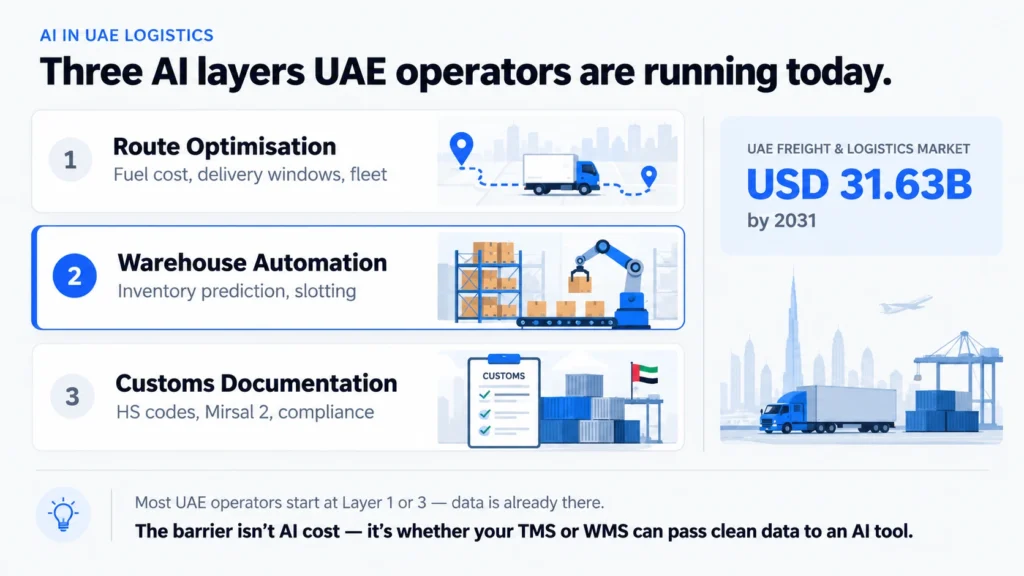
- 02.UAE logistics operators are running AI across route optimisation, warehouse automation, and customs documentation — the operational layer, not supply-chain transformation.
- 03.Mid-size freight forwarders, couriers, and 3PLs can start with route optimisation or customs-automation AI without needing a data science team.
- 04.The biggest barrier for most UAE logistics SMEs is not AI strategy — it is connecting AI tools to legacy TMS and WMS platforms that were not built to accept AI outputs.
Why is AI adoption in UAE logistics accelerating now?
The UAE freight and logistics market was valued at USD 21.63 billion in 2025 and is projected to reach USD 31.63 billion by 2031 at a CAGR of 6.55%, according to Mordor Intelligence. That growth rate, combined with the UAE’s position as a global logistics hub, is creating unusual AI in logistics UAE adoption pressure from above and below at the same time. From above, DP World’s investment in Jebel Ali’s AI-driven terminal operating systems, BOXBAY high-bay storage, and automated stacking cranes (ASCs) has set a visible benchmark that the rest of the regional market is measured against. From below, rising fuel costs, driver shortages, and the complexity of serving both the UAE domestic market and regional transit routes are compressing margins on operators who haven’t automated yet.
Two infrastructure changes are making AI in logistics UAE more accessible in 2026 than it was two years ago — and both are specific to the UAE, not generic AI trends. First, UAE customs integration through Mirsal 2 has created a structured data layer across import, export, and re-export flows that AI tools can read directly. Second, the proliferation of cloud-based TMS and WMS platforms with API access means AI tools no longer require bespoke integrations built from scratch — they connect to a data feed that already exists.
AI adoption in logistics UAE used to be gated by whether you could afford a research-and-development team. Now it is gated by whether your existing systems can pass clean data to an AI tool. That shift matters for where you spend the first AED.
No. Freight forwarders and couriers use it for routes, warehouse prediction and customs paperwork. Latent helps mid-size operators choose a first project.
What AI applications are UAE logistics operators running today?
The applications running at scale in UAE logistics fall into three operational layers, each with a different entry barrier and a different type of ROI. For a deeper treatment of how AI handles specific workflow automation tasks across the supply chain, see AI in logistics and supply chain management.
Route optimisation and fleet management
Route optimisation is the most mature AI in logistics UAE application and the one with the clearest, fastest payback. Route optimisation AI takes live inputs — traffic data, delivery windows, driver schedules, vehicle capacity, fuel cost — and produces a route sequence that a human dispatcher couldn’t calculate in the same time or with the same accuracy.
In the UAE, the specific challenge that makes this valuable is the combination of time-sensitive port pickups from Jebel Ali and Khalifa Port, last-mile delivery complexity in dense urban areas like Deira and Downtown Dubai, and cross-emirate routes that span very different road and traffic conditions. AI route planning handles those variables continuously, not once at the start of a shift.
For a fleet of 20 or more vehicles, AI in logistics UAE route optimisation typically pays back within three to six months through reduced fuel consumption and reduced driver overtime. The implementation requires your vehicles to have GPS telematics (standard on most commercial fleets in the UAE already) and your TMS to accept a route file output. If your TMS can accept a CSV or API update, you can integrate route AI without replacing the platform.
Warehouse automation and inventory prediction
At the large end — DP World’s Jebel Ali terminal, BOXBAY’s 792-TEU automated storage system — warehouse AI in logistics UAE operates through robotics, digital twins, and automated stacking cranes that run 24 hours without shift changes. For a mid-size operator, the relevant layer is predictive inventory management and slotting optimisation.
Predictive inventory AI uses historical order patterns, supplier lead times, and seasonal demand signals to calculate safety stock levels and reorder points in real time. Slotting optimisation AI reconfigures where SKUs live in a warehouse based on pick frequency — placing high-velocity items closest to dispatch, reducing travel distance for pickers by 20–30% in deployments where before-and-after data is available.
Both are practical AI in logistics UAE entry points, but they require clean, structured inventory data inside a WMS. A warehouse running on spreadsheets or a WMS that exports only weekly batch reports is not ready to connect to predictive AI. The first investment is making the data flow real-time and accessible — not the AI tool itself.
Customs documentation and trade compliance
This is the most underused application in AI in logistics UAE, despite being one of the most time-intensive manual processes. UAE customs documentation — HS code classification, certificate of origin verification, Mirsal 2 data entry, free zone declaration formats — involves structured, rule-based tasks that AI handles reliably.
Classification AI can assign HS codes to commodity descriptions with accuracy that matches a trained customs agent, at a fraction of the time. Document-parsing AI extracts fields from bills of lading, commercial invoices, and packing lists and maps them into the correct format for Mirsal 2 submission or free zone declaration templates.
For a freight forwarder processing 50 or more shipments per day, customs documentation AI reduces the per-shipment processing time that currently consumes a significant share of back-office headcount. The regulatory risk is manageable because the AI produces a draft output that a human confirms before submission — it is a productivity tool, not an autonomous agent filing declarations on your behalf.
What does AI in logistics UAE mean for mid-size businesses?
DP World and Aramex operate at a scale that justifies nine-figure technology investment. A freight forwarder with 15 trucks or a 3PL running a single Dubai warehouse does not. That gap shapes which AI in logistics UAE applications are actually within reach — and which ones to ignore for now.
The accessible entry points are the three operational layers above — none of which requires a dedicated AI team, a data lake, or a platform replacement. What they do require is that the systems feeding them (TMS, WMS, customs platform) produce structured, real-time data rather than manual entries and weekly batch exports.
This is where most UAE logistics SMEs encounter the real barrier. A TMS built in 2015 or a WMS implemented in a previous generation of the business was not designed to produce an API feed. Connecting modern AI tools to those platforms requires modernisation work — not a full replacement, but a layer of integration and data pipeline engineering. Our legacy logistics systems built before AI was a consideration work exists precisely for this reason: the AI tool is usually the smaller part of the project; the data plumbing is where the work actually lives.
The practical AI in logistics UAE question is not “which platform should we buy?” It is “which of our operational processes wastes the most staff time on tasks that follow a predictable pattern?” Start there.
What does the UAE regulatory environment mean for AI in logistics UAE?
AI in logistics UAE does not currently face a dedicated regulatory framework the way clinical AI in healthcare does. There is no Ministry of Economy or FTA registration requirement for deploying route optimisation or warehouse prediction AI. The relevant regulatory considerations are narrower and more practical.
UAE Personal Data Protection Law (PDPL), Federal Decree-Law No 45 of 2021, governs any AI system that processes personal data — including driver data, customer contact records, and consignee details captured in shipment records. An AI tool that ingests driver location data or customer delivery preferences must comply with PDPL’s consent, storage, and data subject rights requirements.
Free zone jurisdiction matters for data storage and processing. A logistics operator in JAFZA is subject to JAFZA’s own data governance rules alongside federal PDPL. An operator in DAFZA (Dubai Airport Freezone) faces slightly different permit and data handling requirements. Confirm your free zone authority’s current guidelines before deploying any AI system that processes shipment or customer data externally.
Customs AI output is not exempt from human review under current Mirsal 2 rules. Any classification or declaration generated by an AI tool must be confirmed by a licensed customs agent before submission. This is the practical constraint that shapes how customs AI is deployed — as a productivity multiplier for your customs team, not as an autonomous filing system.
For most operational AI applications — route planning, warehouse slotting, fleet maintenance prediction — regulatory compliance means PDPL, your labour law obligations around driver data, and your free zone authority’s data governance rules. A standard deployment does not require a lawyer.
How do you choose your first AI in logistics UAE project?
Pick the operational process that consumes the most predictable staff time, produces structured output, and already has data flowing through a system — even imperfectly. That is the right first AI in logistics UAE project.
For most UAE logistics operators, that process is one of three things. Route planning dispatched manually by a senior driver or operations manager is the most common starting point: the process is already structured (addresses, time windows, vehicle types), the data already exists in a TMS or spreadsheet, and the improvement is immediate and measurable in fuel and time. Customs documentation entry is the second most common — particularly for freight forwarders processing high volumes of similar commodity types where HS code classification is repetitive. Inventory reorder management is the third, particularly for 3PLs running bonded warehouses where stockout costs are high.
In all three cases, start with the output: define what “good” looks like (a route plan, a classified HS code, a reorder recommendation), then work backwards to the data the AI needs to produce it. For most AI in logistics UAE deployments, if the data is clean and accessible, the tool deployment is typically weeks, not months. If the data is messy or locked in a legacy system, the real project is the data plumbing — and the AI tool follows once that work is done.
Other UAE industry guides: AI in UAE banking, AI in UAE retail and AI in healthcare in the UAE.
Tell us where your team loses the most time, from routing to documents. Latent will scope one project and prototype it before you invest.
Conclusion
AI in logistics UAE is already running at the largest operators, and the operational applications — route optimisation, warehouse prediction, customs documentation — are accessible to mid-size businesses without a transformation project. The entry barrier is not AI capability or cost. It is whether your existing logistics platforms can pass clean, structured data to an AI tool. If they can, the first AI in logistics UAE deployment is typically a matter of weeks. If they cannot, the work is in the data integration layer. Start with one process, map the data it already produces, and build from there — rather than waiting for a strategy document that positions AI as a company-wide initiative.
Frequently Asked Questions
What is AI being used for in UAE logistics?
AI in logistics UAE runs across three operational layers today: route optimisation and fleet management (real-time route planning that reduces fuel cost and delivery time), warehouse automation and inventory prediction (safety-stock calculation, slotting optimisation), and customs documentation (HS code classification, document parsing for Mirsal 2 submission). Route optimisation is the most widely deployed application for mid-size operators.
Is AI in logistics UAE regulated?
AI in logistics UAE does not face dedicated sector-specific regulation. The relevant frameworks are the UAE Personal Data Protection Law (PDPL, Federal Decree-Law No 45 of 2021), which governs how driver and customer data is processed, and your free zone authority’s own data governance requirements. Customs AI output must still be confirmed by a licensed customs agent before submission under current Mirsal 2 rules.
How large is the UAE logistics market?
The AI in logistics UAE sector sits within a freight and logistics market valued at USD 21.63 billion in 2025 and projected to reach USD 31.63 billion by 2031, growing at a compound annual growth rate of 6.55%, according to Mordor Intelligence. Air freight accounts for 46.62% of current market value, with sea and inland waterways growing fastest at 8.55% CAGR.
Where should a UAE logistics operator start with AI?
Most AI in logistics UAE projects that succeed start with the process that consumes the most predictable staff time and already has structured data flowing through a system. For most mid-size UAE operators, that is route planning (if you run a fleet), customs documentation entry (if you process high volumes of similar shipments), or inventory reorder management (if you run bonded or third-party warehousing). None of these require a data science team or a platform replacement.
What is the biggest barrier to AI adoption for UAE logistics SMEs?
The most common barrier to AI in logistics UAE is not cost or strategy — it is legacy logistics platforms. A TMS or WMS built before 2018 typically does not produce real-time structured data that AI tools can consume directly. Connecting AI to those systems requires integration and data pipeline work. The AI tool itself is usually the simpler part of the project; the data plumbing is where most of the effort goes.
Usually a reply within one working day.