Article Overview
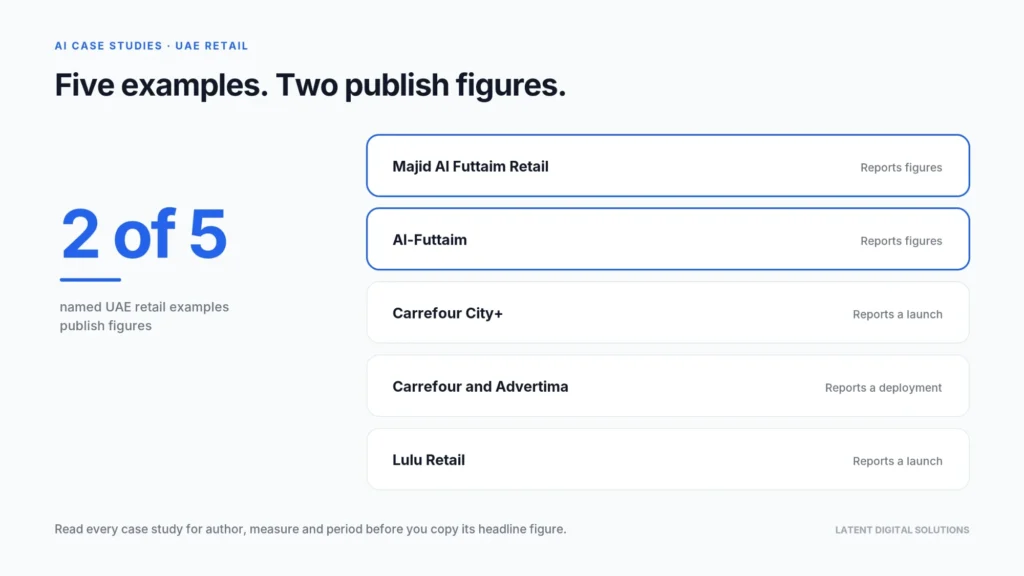
AI implementation case studies UAE retail buyers can verify are rarer than the headlines suggest. In fact, five named examples have public sources, and only two of them report figures. This guide sets out what each company did, what its source says and how to read the numbers.
Use these AI implementation case studies UAE retail groups have published to judge how far a retail AI pilot for a UAE business can follow them, and which parts only large groups can copy.
- AI implementation case studies UAE retail teams can check are limited. We found five named examples with public sources: two report figures and three report only what was deployed, so the reader must separate results from announcements.
- Majid Al Futtaim Retail reports saving USD 1 million annually from a data and Azure OpenAI programme. Al-Futtaim reports 30% lower marketing spend per acquisition and 25% higher campaign conversion on a data platform. Both are vendor-published stories.
- Read AI implementation case studies UAE retail firms publish for author, measure and period. One source below gives three different times for the same task, which shows why a headline figure needs a second look.
- A mid-size retailer can start with one use case, a baseline and a short fixed-scope pilot. The examples here come from large groups, so copy the method, not the scale.
What are some case studies of successful AI implementation in the UAE retail sector?
An AI implementation case study is a written account of what a company built with AI, why, and what changed afterwards. The five below are named, sourced and dated. For each one, the write-up says who the company is, what it did and what the source states. Where no result is published, it says so plainly. AI implementation case studies UAE retail readers meet fall into two kinds: reported results and reported launches. Read each write-up as a report, not as a promise that the same result is available to you.
Two of the five come from Microsoft customer stories, two from trade press on launches and one from a retailer’s own news page. None is Latent client work. Figures appear exactly as each source states them, without rounding or combining. Importantly, treat every figure as self-reported by the company or its vendor, because none of these pages shows an independent audit. For a wider sector-by-sector view, read our guide to AI transformation examples.
Majid Al Futtaim Retail: Azure OpenAI for pricing, feedback and contracts
Majid Al Futtaim Retail holds exclusive rights to the Carrefour brand in 32 countries and operates over 450 stores in 14 nations. In a Microsoft customer story (2025), it describes three Azure OpenAI solutions built on centralised data. The company presents the work as part of an Enterprise Data Management initiative.
“Spider” sets competitive prices across 7 million SKUs in 14 markets. “Geo” analyses the demographics of each neighbourhood to support personalised offers. “Excellence” analyses 60,000 to 70,000 customer responses a week and extracts information from store contracts.
The story’s summary reports that the company saved USD 1 million annually and cut feedback processing from seven days to three hours. However, the headline says three minutes, and the chief digital officer is quoted as saying three to four minutes. The summary credits Azure Synapse, Power BI and Azure OpenAI Service together, so the saving is not split by tool. It is stated as annual, and no baseline is given.
Al-Futtaim: a data platform behind personalised marketing
Al-Futtaim is a Dubai-based group with more than 100 entities across 18 markets. In a Microsoft customer story (2026), it describes building a data platform on Azure with Azure Databricks and Microsoft Fabric, so that separate businesses could work from one view of the customer. Al-Futtaim says it first committed to becoming a fully cloud-enabled organisation.
Its Blue digital platform connects 200-plus brands and nearly 600K monthly users, and supports personalised engagement. The story reports a 30% reduction in marketing spend per acquisition and a 25% increase in campaign conversion rates. Importantly, it is about a data platform, and it does not say how much of the result comes from AI models. The summary gives no baseline or period beside either figure. As a result, a reader cannot tell what the percentages were measured against.
Carrefour City+: the region’s first checkout-free store
A checkout-free store is a shop where customers pick items and walk out, with payment taken automatically. Majid Al Futtaim opened Carrefour City+ at Mall of the Emirates, and Campaign Middle East (2021) covered the launch. Customers enter through the Carrefour app, and AI identifies the products they take.
The article says the store stocks over 1,300 items and that the technology identifies thousands of products with pinpoint accuracy. It adds that this is a first for Carrefour worldwide, and that the UAE’s Minister of State for Artificial Intelligence inaugurated the store. It publishes no accuracy percentage, sales figure or later result. In other words, this is a launch announcement, not a measured outcome. Treat solving business problems with technology as the test here: what changed for the shopper, and how would you know?
Carrefour and Advertima: in-store audience screens
Retail media is advertising sold to brands on a retailer’s own screens, app or website. In an announcement carried by Communicate Online (2025), Majid Al Futtaim’s retail media network, Precision Media, said Carrefour had deployed Advertima’s Audience AI across its UAE hypermarkets.
For example, the system uses 3D sensors to identify shopper types, such as families or young professionals, and shows tailored messages on digital screens. It also links in-store data with online profiles, so a customer who browsed baby products online might later see a relevant promotion in the store. The report names plans to extend the system to supermarkets. The announcement is dated May 2025 and describes a partnership between Precision Media and Advertima. It states no measured result. Therefore, treat it as a deployment, not a case with proven returns.
Lulu Retail: AI robots in 30 stores
Lulu Retail launched what it calls the UAE’s first in-store robotic media network, with Kody. Lulu’s news release (2026) says the AI-powered Odigo robots move autonomously, help shoppers find departments and products, and show brand content that can change in real time by location, store or market.
Gulf Time’s report (2026) of the same launch says 62 robots operate across 30 stores. However, neither source gives a result, such as sales or engagement. The release quotes Lulu Retail’s chief executive saying the initiative strengthens customer engagement and gives brand partners a new platform. That is a stated aim, not a result, and the launch dates from October 2026. Neither page says what the network costs to run or how often a robot conversation ends in a purchase.
Send Latent the retail process you would like to improve first. Latent will say plainly whether a short fixed-scope pilot can test it, and what to measure before you start.
How do you read AI implementation case studies UAE retail firms publish?
Read AI implementation case studies UAE retail firms publish with four checks, applied in the same order every time. For instance, the best-documented example contradicts itself on a key number, and the others publish no result at all. If you want a partner to build on your own data first, ask for a working prototype on your data, because a prototype shows what the tool does with your data, not with someone else’s.
| Check | Why it matters | What to ask |
|---|---|---|
| Who wrote it | A vendor story promotes the vendor. | Is there an independent source? |
| What was measured | A figure with no measure proves nothing. | Saved, reduced or increased what? |
| Over what period | A yearly figure differs from a launch week. | What is the baseline and date? |
| What caused it | Several changes may sit behind one result. | How much came from AI itself? |
What do these case studies leave out?
AI implementation case studies UAE retail teams read rarely show the hard parts. From our research, the pages we read do not state what any project cost or how long it took, and none describes what failed along the way. Those are the questions a mid-size buyer most needs answered.
In addition, three of the five report no outcome at all, so only two give figures to test. Therefore, treat a case study as a starting question, not a verdict. A mid-size retailer should also ask what skills and tools each project needed, because the sources are silent on that too. Ask the company, or the partner that built it, for the baseline, the period and the cost before you copy anything. A figure that arrives without those three details is a headline, not evidence you can plan a budget around.
What do the successful examples have in common?
The AI implementation case studies UAE retail teams can check share a few patterns that the sources themselves show, and these are the only patterns worth drawing. All five come from large groups, and none is a mid-size retailer. For tasks a smaller team can try instead, see our guide to generative AI use cases in retail.
Specifically, two of the five start from data. Majid Al Futtaim Retail’s story begins with centralising fragmented data, and Al-Futtaim built Blue on unified data. Three of the five are in-store technology, and each of those reports a launch, not a result.
In fact, the examples that report numbers are the ones built on data and used in marketing or reporting, which are closer to what a mid-size retailer can try. The sources do not prove why that is so, so read it as an observation, not a rule. Specifically, no source here shows that in-store robots or checkout-free stores paid back.
Where should a mid-size retailer start?
A mid-size retailer reading AI implementation case studies UAE retail groups publish should start with one use case, a recorded baseline and a short pilot, not a store-wide programme. The use cases guide above lists tasks a smaller team can try, and the closest to the sourced examples is classifying customer feedback, which sits in the same family as Majid Al Futtaim Retail’s “Excellence” tool. In particular, choose a task with a clear owner, a weekly volume you can count and a person who can judge the output.
A pilot at Latent is typically a one-to-four-week piece of work, scoped and priced before it starts, so nothing is left open-ended. Specifically, record how long the task takes today, run the pilot on a small sample of real data, and compare the result over the same period. As a result, you can say what changed, in numbers, before you commit to a larger build.
Send Latent the process, the data you hold today and the number you want to move. Latent will scope a short pilot with a fixed scope and price so you can judge the result.
Conclusion
AI implementation case studies UAE retail readers can rely on are few, and the careful ones separate results from launches. Majid Al Futtaim Retail and Al-Futtaim report figures. Carrefour City+, the Advertima rollout and Lulu’s robots report deployments. In particular, read each for author, measure and period.
In addition, keep a short file of what you checked, because it lets a board see how the decision was made. Therefore, copy the method and not the scale: one use case, a baseline, a short pilot and a result you can check. If AI implementation case studies UAE retail teams publish ever tempt you to copy a headline figure, ask for the baseline first. For a second opinion on where to begin, talk to Latent about your retail use case and bring the process and the number you want to move.
Frequently Asked Questions
Which AI use cases are live in UAE retail?
The AI implementation case studies UAE retail teams can verify show five. They are AI-assisted pricing, customer feedback analysis, personalised marketing on a data platform, checkout-free shopping and in-store media. However, only the feedback and reporting work at Majid Al Futtaim Retail and the marketing platform at Al-Futtaim publish figures.
How long do retail AI projects take?
The five sources do not say. Duration depends on scope and data, so ask any partner for a plan with dates. Therefore, compare partners on the same scope. A Latent pilot is usually a one-to-four-week job, agreed at a set scope and price.
What should a retailer measure in an AI project?
Measure one number tied to the process, such as time per task, cost per customer acquired or conversion. In addition, record the baseline first, then compare after the pilot over the same period.
Do you need a data team to start with AI in retail?
Not for a first pilot, but you do need accessible data. Both examples with figures started from a central data platform, so check where your data sits before you begin.
Usually a reply within one working day.