Article Overview
AI in healthcare UAE is no longer something that happens only in government-funded flagship hospitals. Clinics, diagnostic centres, and mid-size hospital groups across Dubai and Abu Dhabi are deploying AI today, for scheduling, imaging, and patient monitoring, with measurable results. If you run a UAE healthcare business and you’re assessing whether AI belongs in your operations, this guide covers what’s actually running, what the regulatory framework requires, and where to start without taking on unnecessary risk or cost. Latent Digital Solutions helps UAE healthcare businesses adopt AI without the complexity, and our custom software for UAE healthcare providers gives teams a practical, compliance-ready entry point.
Key takeaways
- 01.The UAE AI in healthcare market was valued at USD 39 million in 2024 and is projected to reach USD 337.9 million by 2033, growing at a CAGR of 24% (IMARC Group, via healthorbit.ai).
- 02.UAE hospitals are already using AI for medical imaging, patient monitoring, and sepsis prediction — these are operational deployments, not pilot programmes.
- 03.Regulatory oversight sits across three bodies: DHA (Dubai), DoH (Abu Dhabi), and MoHAP (federal). Administrative AI tools are typically outside medical device registration requirements.
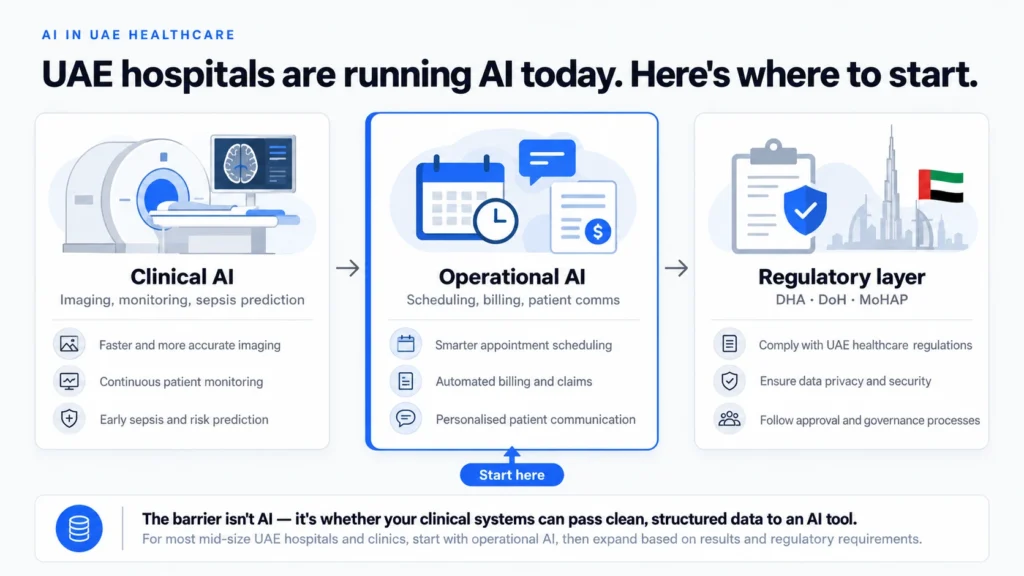
- 04.For mid-size healthcare businesses, the practical entry point is operational AI — scheduling, billing, and patient communication — not clinical diagnostic tools.
Why AI in healthcare UAE is accelerating now
The speed of AI adoption across UAE healthcare reflects deliberate government investment, not organic market drift. The Ministry of Health and Prevention (MoHAP) established the health sector’s first Centre of Excellence for AI in 2023. The UAE then finalised the deep integration of Riayati, Malaffi, and NABIDH, its three national health data platforms, enabling clinicians to access unified patient records across all seven emirates.
That infrastructure change matters for businesses. Before unified data platforms existed, getting started with AI in healthcare UAE meant building your own data pipeline first. Now, for providers connected to the national platforms, the data layer is already in place. The remaining work is deciding which operational problem to solve with it.
Federal Decree-Law No 38 of 2024, which came into effect in January 2025, provides the primary legislative framework governing AI medical software. It brought AI-enabled diagnostic tools, monitoring devices, and clinical decision support systems under the same registration requirements as other medical products.
Clinics and diagnostic centres across the UAE use it for scheduling, imaging and monitoring. Latent helps you choose a first project that fits your size.
What UAE hospitals are already doing with AI
The gap between what’s claimed about AI in healthcare UAE and what’s running on the ground is narrower than most businesses expect. Reporting by Zawya on Abu Dhabi and Dubai hospitals stepping up AI use in patient care documents specific deployments across the country’s flagship facilities.
Diagnosis and medical imaging
The most visible AI in healthcare UAE deployments are in imaging and diagnostics. Cleveland Clinic Abu Dhabi uses Transpara, an AI-assisted imaging tool, to analyse digital mammograms and identify suspicious areas before clinician review. The same facility uses an intelligent radiotherapy planning system that adjusts treatment doses to protect surrounding healthy tissue. These run in standard clinical workflows, day to day.
Al Jalila Children’s Hospital deploys algorithm-assisted digital EEG devices to predict epileptic seizures before onset. Tawam Hospital uses Histotripsy technology for non-invasive liver tumour treatment. Fujairah Government Hospital has introduced digital imaging capsules that capture high-resolution digestive tract images without conventional endoscopy.
Patient monitoring and early warning
Patient monitoring is the second major area where AI in healthcare UAE is running in live clinical environments. Sheikh Shakhbout Medical City operates smart inpatient rooms with contactless sensors that monitor vital signs and predict fall risks continuously. Wireless mobiCARE devices provide real-time ECG monitoring with immediate data transmission to clinical teams.
Sheikh Khalifa Medical City and Al Ain Hospital deploy predictive algorithms that identify sepsis risk hours before onset. Abu Dhabi’s Department of Health runs an AI-powered patient risk profiling system across all hospitals and clinics, enabling early intervention based on each patient’s full medical history.
Administrative and workflow automation
This is the layer most relevant to mid-size healthcare businesses. Scheduling, billing, insurance pre-authorisation, and patient communication are all areas where AI in healthcare UAE is running at scale without requiring clinical regulatory approval. The distinction matters because the regulatory pathway for administrative AI is entirely different — and much simpler — than for clinical tools.
For a detailed breakdown of how agentic AI handles these tasks specifically, see agentic AI use cases in healthcare.
What this means for mid-size UAE healthcare businesses
Major hospital groups have capital, data infrastructure, and dedicated digital health teams. A 50-bed private hospital or a multi-branch diagnostic centre typically doesn’t. That gap shapes which AI in healthcare UAE applications are actually accessible to you.
The administrative automation layer has a low entry barrier. Insurance pre-authorisation workflows, appointment scheduling, patient reminder sequences, and billing reconciliation are all processes where AI can reduce manual work without touching the clinical pathway. These don’t require DHA or DoH device registration because they don’t influence a clinical decision directly.
A peer-reviewed study published in PMC examining physician AI adoption barriers in the UAE found that fragmented data systems were the leading obstacle for UAE doctors, followed by insufficient training and limited patient acceptance. For businesses operating within the national Riayati or NABIDH ecosystem, the data fragmentation barrier is partly addressed at the infrastructure level. Training and patient communication, however, remain the organisation’s responsibility.
This means the practical business question isn’t “can we afford AI?” It’s “which administrative process wastes the most of our staff’s time today?” Start there.
What does the UAE regulatory framework mean for AI in healthcare UAE?
Regulatory oversight of AI in healthcare UAE is split across three bodies, and understanding which one governs your organisation is the first step before any AI in healthcare UAE deployment in a clinical setting. Understanding which one applies to your organisation determines your implementation pathway.
MoHAP (federal) governs the country-wide framework. Federal Decree-Law No 38 of 2024 sets the registration requirements for AI medical software at the federal level, covering any AI tool that influences a clinical decision.
DHA (Dubai Health Authority) governs Dubai-based providers. DHA requires AI-enabled medical software used in clinical settings to meet its specific registration and approval criteria before deployment in Dubai facilities.
DoH (Department of Health Abu Dhabi) published the Policy on Use of Artificial Intelligence in the Healthcare Sector, the UAE’s first jurisdiction-specific AI healthcare policy, which sets the governance standard for Abu Dhabi providers.
For administrative AI tools (scheduling, billing, communication, reporting), the regulatory pathway is more straightforward. These tools don’t qualify as medical devices or clinical decision support systems under current definitions, so they don’t require device registration. The UAE Personal Data Protection Law (PDPL) still applies, and any tool handling patient data must comply with data sovereignty and consent requirements.
If you’re considering clinical AI, factor in a 6–12 month regulatory pathway as part of your project timeline before budgeting or procurement.
How to start: choosing your first AI project
Most organisations adopting AI in healthcare UAE successfully started with a single, high-impact operational process rather than an organisation-wide programme.
Begin with the most burdensome administrative task
Look at your operations and identify the task that consumes the most staff time without requiring clinical judgement. For many UAE clinics and hospitals, this is insurance pre-authorisation, a rule-based process that matches clinical codes against insurer criteria and can be handled by AI with minimal clinical oversight. Scheduling, patient reminders, and billing reconciliation are close seconds.
Starting with administrative automation also avoids the regulatory complexity of clinical AI. You get measurable ROI in reduced staff hours and faster reimbursement cycles, and your team builds familiarity with AI-assisted workflows before anything more complex arrives.
Prioritise data integration before adding AI
The PMC study on UAE physician AI adoption found data fragmentation to be the leading barrier. Before you layer AI onto a process, confirm that the data feeding that process is clean, accessible, and centralised. An AI scheduling tool connected to three separate calendar systems and two insurance portals will not perform reliably.
If your organisation is already connected to Riayati, NABIDH, or Malaffi, you have a head start. If not, the first investment should be in connecting your core systems before deploying AI on top of them. Our custom-built AI tools for UAE healthcare teams always start with a data readiness assessment for this reason — it’s the step most vendors skip.
Other UAE industry guides: AI in UAE banking, AI in UAE retail and AI in logistics in the UAE.
Tell us which task is slowest, such as scheduling or reporting. Latent will check the data rules and prototype one use first.
Conclusion
AI in healthcare UAE is already deployed at scale across the country’s flagship hospitals. For mid-size providers, the accessible entry point is the operational layer: scheduling, billing, patient communication, and monitoring alerts. This doesn’t require clinical regulatory approval. It produces measurable ROI and builds the internal capability your team needs before tackling anything more complex. Start with one process. Quantify the manual time it consumes. Then build for that specific problem rather than the entire operation at once.
Frequently Asked Questions
What is AI being used for in UAE healthcare?
AI in healthcare UAE runs across three main areas: medical imaging and diagnosis (mammogram analysis, radiotherapy planning, EEG seizure prediction), patient monitoring (sepsis prediction, fall risk detection, continuous ECG), and administrative automation (scheduling, billing, insurance pre-authorisation). Administrative applications are the most accessible for mid-size providers without a dedicated digital health team.
Is AI in healthcare UAE regulated?
Yes. Federal Decree-Law No 38 of 2024 governs AI medical software at the federal level. Clinical AI tools that influence a diagnostic or treatment decision require registration with DHA (Dubai), DoH (Abu Dhabi), or MoHAP depending on where you operate. Administrative AI tools are not typically classified as medical devices, so they follow a simpler compliance pathway.
How large is the UAE AI healthcare market?
The AI in healthcare UAE market was valued at USD 39 million in 2024 and is projected to reach USD 337.9 million by 2033, at a compound annual growth rate of approximately 24%, according to IMARC Group data reported by healthorbit.ai.
Where should a UAE clinic or hospital start with AI?
Most organisations starting with AI in healthcare UAE begin with their most burdensome administrative process. Insurance pre-authorisation, scheduling, and billing reconciliation are the three most common starting points for mid-size UAE healthcare organisations. These processes don’t require clinical device registration, they produce measurable ROI, and they give your team time to build familiarity with AI-assisted workflows before moving into clinical applications.
What are the main barriers to AI adoption in UAE healthcare?
Organisations scaling AI in healthcare UAE face three primary barriers, identified in a peer-reviewed study of UAE physicians: fragmented data systems across facilities, insufficient training and resources for clinical staff, and limited patient acceptance of AI-assisted care. Organisations connected to the national Riayati or NABIDH platforms have a structural advantage on data fragmentation, but training and patient communication remain the organisation’s own responsibility to address.
Usually a reply within one working day.